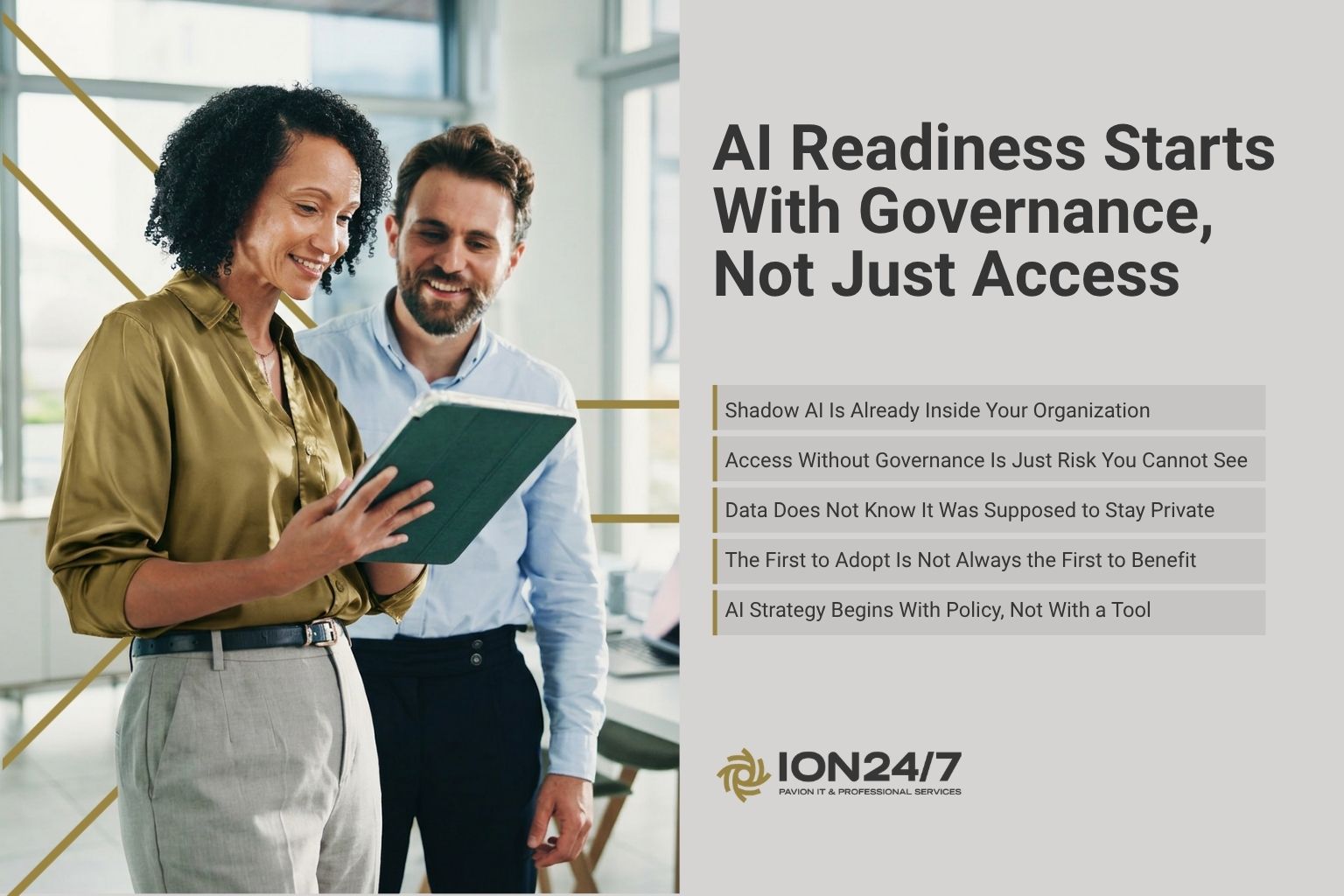
Artificial intelligence is no longer a future business discussion. It is already being used inside organizations every day, whether leadership teams realize it or not.
Employees are using AI tools to summarize meetings, write emails, analyze spreadsheets, generate reports, and search for information faster. While these tools can improve productivity, they also introduce significant security, compliance, and operational risks when businesses adopt AI without governance.
The question is no longer “Can we use AI?” The real question is whether your organization is prepared to use it responsibly.
What AI Governance Actually Means
AI governance is the framework that determines how artificial intelligence tools can safely interact with your business, employees, and data.
Without governance, AI adoption quickly becomes fragmented. Different teams begin using different tools with little visibility into where company data is going, how it is being stored, or who owns the output being generated.
Strong AI governance helps organizations establish:
- Acceptable AI usage policies
- Security and access controls
- Data classification standards
- Approval processes for AI tools
- Employee training and accountability
- Compliance and auditing procedures
Businesses that fail to address these areas now may find themselves struggling to regain control later.
The Risks of Uncontrolled AI Usage
One of the biggest misconceptions about AI adoption is that it only affects IT departments. In reality, AI usage often begins organically across the organization before formal policies are ever created.
This creates what many experts are now calling “shadow AI.”
Employees may unknowingly upload sensitive information into public AI tools, including:
- Customer data
- Financial information
- Internal documentation
- Contracts
- Proprietary business strategies
- HR information
Once that data enters a public model, businesses may lose visibility into how it is stored, processed, or potentially used.
Companies without an AI policy are already behind. Companies without AI architecture planning risk building disconnected systems that create more problems than they solve.
Public vs. Private AI Models
Not all AI platforms operate the same way.
Public large language models (LLMs) are widely accessible and easy to use, but they may present greater concerns around data privacy and governance depending on how they are configured.
Private AI environments provide businesses with more control over:
- Data handling
- Security policies
- Internal access
- Compliance requirements
- Knowledge management
Organizations should carefully evaluate where AI tools can safely access company information and where restrictions should exist.
The goal is not to prevent AI adoption. The goal is to implement AI intentionally.
Why Data Classification Matters
Many organizations still lack clear data classification policies, which becomes even more dangerous when AI tools enter the workplace.
Employees cannot protect information properly if they do not understand:
- What data is confidential
- What data can be shared externally
- What information should never enter an AI tool
- What systems require restricted access
AI governance should align closely with broader cybersecurity and compliance initiatives.
Businesses that understand their data environment will be in a far stronger position to adopt AI safely.
Building an AI Strategy Before Problems Start
AI can absolutely improve operational efficiency, collaboration, and decision-making. However, businesses that rush into adoption without planning often create unnecessary complexity and security gaps.
An effective AI strategy should include:
- Security assessments
- Governance policies
- Employee training
- Infrastructure planning
- Access controls
- Compliance reviews
- Long-term architecture considerations
The organizations that benefit most from AI will not necessarily be the first to adopt it. They will be the ones that build a secure, scalable foundation around it.
As AI continues evolving, governance and operational planning will become just as important as the technology itself.
